Rubber lining’s effectiveness isn’t just about the material itself; it’s about the way it’s applied to ensure it lasts. At US RUBBER, our rubber lining procedure is designed to deliver maximum durability and performance through a carefully controlled, step-by-step process.
How Our Rubber Lining Procedure Works
From surface preparation and material selection to application, curing, and inspection, every stage is executed with precision. Our focus on safety, environmental controls, and rigorous quality standards ensures each project meets the highest benchmarks for long-term reliability.
Step 1: Surface Preparation
The first step in a successful rubber lining procedure is to prepare the surface. All substrates must be free of dirt, grease, mill scale, rust, and old coatings to ensure proper adhesion. Depending on the project, this may involve abrasive blasting, grinding, and/or chemical cleaning.
During surface preparation, it’s important to maintain a clean, dust-free environment. Any contaminants that settle on the surface of the substrate can affect bonding and adhesion.
Step 2: Material Selection
Not all rubber linings are the same. Different industrial environments and applications require different rubber compounds. Material choice usually depends on these factors:
- Chemical resistance: Protection against acids, alkalis, or solvents
- Temperature tolerance: Ability to withstand thermal cycling
- Abrasion resistance: Durability in slurry or high-friction environments
- Flexibility: Adaptability to complex geometries or movement
- Service life expectations: Matching compound properties to long-term performance needs
Our team evaluates each project individually, selecting from a range of great rubber lining materials to match the specific needs of the application, whether it be for tanks, vessels, or piping systems.
Step 3: Application of the Rubber Lining
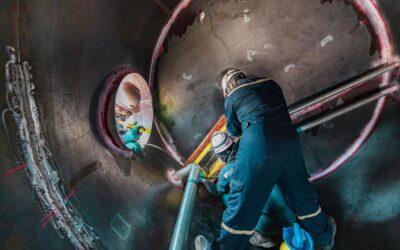
With the substrate prepared and materials selected, the rubber lining is carefully applied. Depending on specific project requirements, linings may be hand-applied, sheet-applied, or formed to fit complex geometries.
During application, our technicians follow strict safety protocols and environmental controls. The rubber is positioned, bonded, and rolled out to eliminate air pockets and ensure complete contact with the substrate.
The precision at this stage is incredibly important because any gaps or misalignment could compromise the lining’s integrity and performance.
Step 4: Curing the Rubber Lining
After application, the lining undergoes curing, which activates the rubber’s chemical properties and locks in its strength and flexibility. Curing can be done through stream, autoclave, or other controlled heating methods, depending on the material and equipment.
Temperature and time are carefully monitored during curing so that the rubber fully bonds to the substrate and develops the mechanical and chemical resistance needed to withstand industrial conditions. At US RUBBER, we never rush the curing process because we believe quality takes precedence over speed. It will save you time and money in the long run, after all.
Step 5: Inspection and Testing
No rubber lining procedure is complete without a thorough inspection. After curing, the lining undergoes a series of tests to confirm proper adhesion, thickness, and overall integrity.
Here are some common inspection and testing methods.
| Test Method | Purpose | When Used |
| Spark Testing | Detects pinholes or weak spots | Post-curing, before service |
| Ultrasonic Testing | Measures lining thickness | During final inspection |
| Visual Examination | Ensures uniform coverage and integrity | Throughout entire installation |
| Adhesion Testing | Confirms bond strength to substrate | Final quality verification |
These tests verify that the lining meets performance requirements and will deliver long-term protection. Only after passing all inspections is equipment cleared for service.
Safety and Quality at Every Stage
Throughout each phase of the rubber lining procedure, we prioritize safety and quality. Environmental controls protect both the workers and the finished lining, while rigorous inspections ensure reliable adhesion and durability. By following industry best practices and our own safety and quality standards, we deliver solutions that minimize downtime and extend the operational life of critical assets.
Get Expert Rubber Lining Installation From US RUBBER
A successful rubber lining installation is the result of precision, planning, and strict quality control. At US RUBBER, our commitment to safety and quality ensures that every project is completed to the highest standards, providing long-term protection against corrosion, abrasion, and chemical attacks.
If your facility needs tank, vessel, or piping protection, trust us to deliver proven solutions. Contact our team to learn more about our rubber lining services and how we can help you extend the lifespan of your equipment.