Rubber liners mining companies rely on staying durable because rubber flexes instead of fracturing. It absorbs impact energy from falling rock, wears down slowly under abrasive contact, and forms a watertight seal that keeps slurry and corrosive moisture off the steel underneath. Rigid materials crack or dent under the same loads. Rubber deforms, recovers, and keeps working.
In mining, equipment is not just exposed to tough conditions. It is under constant attack. Chutes, tanks, pipelines, and screening systems face relentless wear from abrasive ore, high-impact rock loads, and fast-moving slurry that erodes surfaces from the inside out. Without protection, even heavy-gauge steel wears through quickly, which means costly repairs and unscheduled downtime. Abrasion resistant rubber liners mining crews install are the standard answer. This article covers how lining works, where it delivers the most value, and how to choose the right rubber for mining service.
The Harsh Realities of Mining Environments
Mining sites are among the most demanding industrial environments anywhere. From extraction through processing and transport, equipment absorbs a combination of forces that degrades unprotected surfaces fast, which is why rubber liners mining operations have become standard rather than optional.
Common Threats to Mining Equipment:
- Abrasion: Constant contact with sharp, coarse material grinds down surfaces over time.
- Impact: Heavy rocks and materials drop from significant heights, striking chutes, hoppers, and bins with force.
- Slurry Erosion: Slurries (mixtures of fine solids and water) flow through pipelines and tanks at high speeds, gradually eating away at unprotected surfaces.
- Corrosion: Exposure to water, chemicals, and minerals can corrode unlined metal components.
Mining Equipment at Risk:
- Chutes and Hoppers: Handle large volumes of falling rock and aggregate.
- Pipelines and Slurry Lines: Transport abrasive mining slurry at high velocity.
- Tanks and Process Vessels: Store and mix corrosive materials and abrasive solids.
- Mill Feed Boxes and Cyclones: Sit in the path of high-energy slurry flow all shift, which is where rubber liners mining sites install earn their keep fastest.
The Cost of Equipment Damage:
- Unplanned Downtime: Unexpected failures bring operations to a standstill.
- Repair and Replacement Costs: Frequent repairs drive up maintenance expenses.
- Lost Productivity: Idle equipment delays production and shipment schedules.
In an environment this hostile, standard materials do not hold up. Even high-strength steel fails early without a wear surface in front of it, and that is exactly the job abrasion resistant rubber liners mining operations depend on are built to do.
Why Rubber Lining Works in Mining Applications
Rubber lining is an engineered wear surface, not a coating. Rubber liners mining operations handle high-impact rock drops and abrasive slurry flow by creating a flexible barrier between the process and the substrate. Choosing the right rubber for mining duty comes down to matching compound to the specific mix of impact, abrasion, chemistry, and temperature on that line.
Here’s why rubber is so effective:
- Exceptional Impact Absorption
Rubber’s natural elasticity allows it to absorb shock and deformation without cracking. That flexibility makes it ideal for chutes, hoppers, and other high-impact areas where rigid materials like steel or ceramic might shatter or dent. - Superior Abrasion Resistance
This is the property behind rubber liners mining companies specify for their highest-wear assets: rubber tolerates continuous scraping and grinding from coarse media, wearing slowly and evenly instead of gouging. - Seamless Protection Against Slurry and Corrosion
Properly applied rubber linings form a watertight seal that prevents slurry infiltration and moisture-induced corrosion — two of the most damaging forces in slurry-based operations. - Chemical and Temperature Resistance
Compounds can be selected to resist specific chemistries or handle wide temperature swings, so the rubber for mining acid circuits is not the rubber used on hot, dry ore. - Long-Lasting Performance Under Stress
Rubber linings remain bonded and functional even under repeated flexing, vibration, and movement (conditions that often cause rigid linings to crack or break apart).
In short, rubber adapts to both the mechanical and chemical demands of a mining circuit. That adaptability is why abrasion resistant rubber liners mining engineers tend to outlive the equipment they protect.
Key Applications of Rubber Lining in the Mining Industry
Rubber lining plays a vital role in mining equipment, particularly where abrasion, impact, and slurry erosion are most intense. By applying the right type of rubber lining to the correct component, mining operations can dramatically increase equipment lifespan and reduce unplanned downtime.
Chutes and Hoppers
These take constant bombardment from falling rock and ore. Lining absorbs impact energy, cuts surface damage, and reduces cracking and denting. It also limits material hang-up, so flow stays smooth and clogs are less frequent. Rubber liners mining crews install here typically show the fastest visible payback.
Pipelines and Slurry Transport Lines
High-velocity slurry can wear through unlined metal pipe in months. A rubber liner puts a smooth, resilient surface in the flow path that resists both abrasion and chemical attack, extending pipeline life on the lines that move product. Selecting rubber for mining slurry service depends on solids size, velocity, and pH.
Tanks and Process Vessels
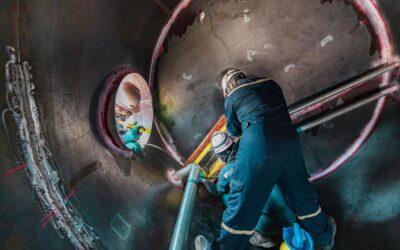
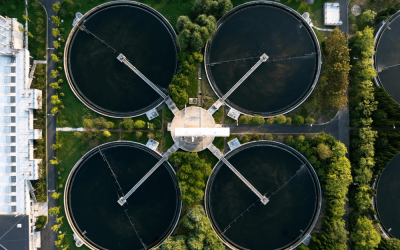
Rubber-lined tanks store and process corrosive and abrasive material without exposing the shell. Lining protects structural integrity, reduces product contamination, and simplifies maintenance, since a worn liner can be replaced without touching the vessel itself. This is where rubber liners mining plants rely on delivering value quietly, year after year.
Rubber Lining Equipment for Mining vs. Alternative Materials
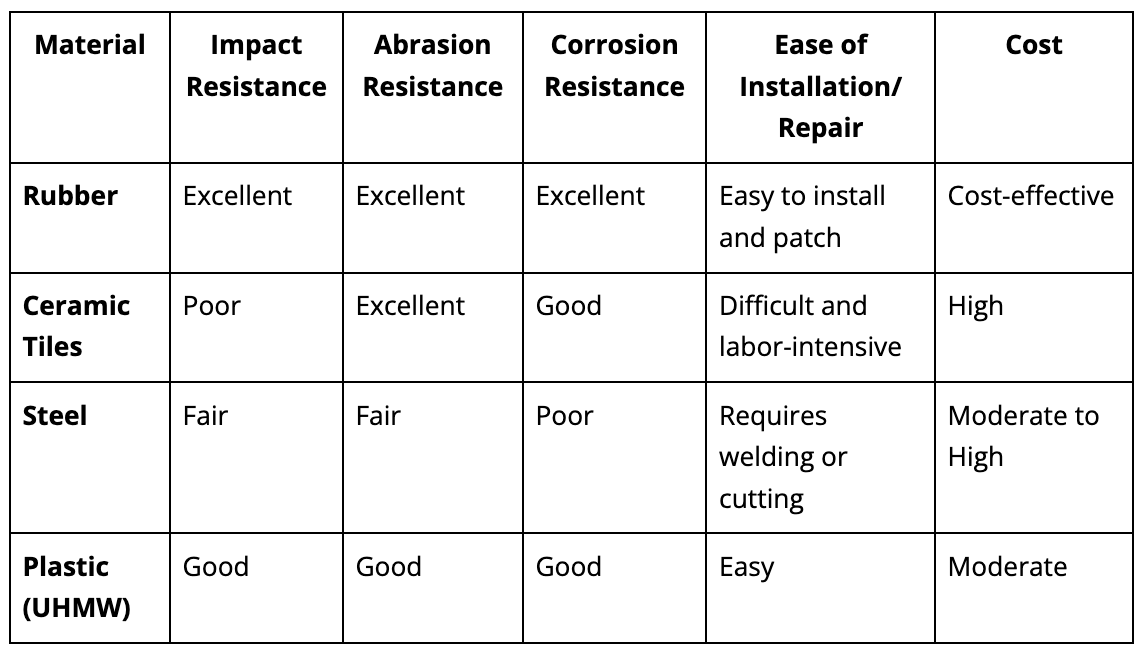
Several materials compete for the same job. Ceramic wins on pure abrasion resistance but shatters under impact and is expensive to repair in place. Chrome carbide overlay handles sliding abrasion well but adds significant weight and is difficult to form around complex geometry. Polyurethane performs in fine-particle service but degrades faster with heat and certain chemistries. Rubber sits in the middle on every axis and wins on the combination: impact tolerance, abrasion life, chemical flexibility, weight, and installed cost. That balance is why rubber for mining wear protection remains the default, and why abrasion resistant rubber liners mining engineers evaluate keep coming out ahead on total cost.
Let’s take a closer look at how rubber compares to other commonly used lining materials in the mining industry:
When Rubber Is the Best Choice:
- When equipment is exposed to both impact and abrasion (ex. chutes, hoppers).
- When handling abrasive slurry that causes internal pipe wear.
- When chemical resistance is needed.
- When downtime must be minimized, rubber is easier to repair on-site.
When Other Materials Might Be Considered:
- For extreme abrasion with minimal impact (ceramic).
- Where the budget allows for specialized installations (ceramic or steel).
- When dealing with non-impact dry materials, and cost is a priority (plastic).
Long-Term Benefits of Rubber-Lined Mining Equipment
Investing in rubber lining doesn’t just solve short-term wear problems; it delivers long-term value across your entire operation:
1. Extended Service Life for High-Wear Assets
Rubber linings form a durable, flexible barrier that withstands the harshest operating conditions. Equipment lined with rubber lasts significantly longer than unlined or poorly protected components, especially in high-impact or abrasive applications.
2. Reduced Maintenance Frequency and Costs
With rubber-lined systems, repairs are less frequent; when needed, they’re easier and faster to complete. This minimizes labor costs and eliminates the need for full equipment replacements.
3. Fewer Unplanned Shutdowns
Downtime is the biggest profit killer in mining. By taking wear predictably instead of catastrophically, rubber liners mining teams monitor turn surprise failures into scheduled changeouts.
4. Lower Total Cost of Ownership Over Time
While the upfront cost of rubber lining is often lower than that of other materials, the real savings come in long-term performance. Longer equipment life, fewer repairs, and minimized downtime all contribute to a significantly lower total cost of ownership.
Upgrade Mining Equipment Protection with Rubber Lining from US RUBBER
If your equipment is losing hours to wear it should not be taken, it is worth a second look. US RUBBER provides custom lining solutions built for mining service, and helps operators select the right compound, lining method, and application approach for the specific duty each component sees. Choosing the right rubber for mining conditions is a specification decision, not a catalogue one.
Contact US RUBBER to request a consultation or schedule an inspection, and put rubber liners mining conditions actually called for on the components that need them most.