In most cases, relining wins. Rubber lined tanks typically cost 40 to 70 percent less than a new vessel and return to service in days rather than weeks or months. Replacement only makes financial sense when the shell itself has failed structurally. If the steel is sound and the damage is corrosion or chemical attack, a tank rubber lining replacement almost always delivers the lower total cost of ownership.
Some facilities specify rubber lined tanks from day one to guard against corrosion or chemical attack. Others look at lining later, when a vessel starts showing wear. Either way, the same question lands on the maintenance manager’s desk every cycle: line it, or buy new? Below we break down upfront cost, service life, maintenance, downtime, and long-term value so you can plan ahead with confidence.
Understanding Total Cost of Tank Ownership
Total cost of ownership (TCO) is a financial estimate of the direct and indirect costs a system carries across its full life cycle. For rubber lined tanks and unlined vessels alike, TCO includes:
- Initial purchase or repair cost
- Installation and labor
- Downtime during repair or replacement
- Ongoing maintenance
- Expected service life
- Performance and ROI
Sticker price is one line item, not the answer. A cheaper vessel that needs recoating every few years and two extra shutdown weeks is not actually cheaper. That shift in thinking is what reshaped the lined tank market: buyers now compare lifecycle numbers, not invoices.
Upfront Cost Comparison: Tank Replacement vs. Rubber Lining
Tank Replacement. Swapping out an entire vessel is a capital project, not a maintenance item, which is why most plants price out rubber lined tanks first. Replacement costs include:
- New tank fabrication (steel, concrete, or alloy)
- Freight and logistics
- Permitting and regulatory compliance
- Installation and foundation work
- Disposal of old equipment
Depending on size and material, replacement runs into the hundreds of thousands of dollars per tank, before you count the production lost while it happens.
Depending on size and material, replacement runs into the hundreds of thousands of dollars per tank, before you count the production lost while it happens.
- Surface preparation (blasting, cleaning)
- Rubber lining materials
- Installation labor
- Curing and inspection
Pricing across the lined tank market reflects that gap consistently. At 40 to 70 percent less than replacement, rubber lined tanks restore full chemical protection for a fraction of the capital. A 10,000-gallon carbon steel tank that costs roughly $150,000 to replace can often be relined for around $50,000 using high-performance rubber.
Service Life & Durability
Properly applied and maintained, rubber lined tanks commonly last 10 to 20 years or longer. Service life depends on:
- Type of rubber used
- Service environment (temperature, pressure, chemical exposure)
- Application quality and curing process
The cure method matters more than most buyers expect. A shop-cured lining applied under controlled conditions generally outlasts a field-cured one in the same service, and thickness should be matched to the abrasion load rather than the chemical exposure alone.
Lining is also renewable. When the rubber reaches end of life, a tank rubber lining replacement resets the clock on the same shell, on the same foundation. Steel does not work that way, which is one reason the lined tank market keeps expanding across chemical processing and water treatment.
Tank Maintenance and Inspection Requirements
Rubber lined tanks are:
- Easier to inspect because the linings can be visually and spark-tested.
- Easier to repair because localized damage can usually be patched without relining the entire tank.
- Cheaper to maintain because there isn’t a need for recoating every few years like with some epoxy or paint coatings.
New tanks (without rubber lining):
- May require protective coatings anyway, especially for carbon steel.
- Offer good corrosion resistance on day one but cost far more than rubber lined tanks and can still suffer pitting or stress corrosion over time.
A workable cadence is an annual visual check plus spark testing at every scheduled shutdown. Catching a pinhole at that stage costs a patch; missing it can cost the shell.
The practical difference is scheduling. Damage is caught early and patched during a planned outage, so a full reline stays a decision you make on your own timeline. Damage on bare steel is usually caught late, and the fix is a much bigger one.
Downtime and Production Impact
Downtime is the cost most budgets underestimate when weighing rubber lined tanks against a new vessel.
Tank replacement can take weeks or months: decommissioning, demolition, site prep, installation, testing, and ramp-up. Every day offline can cost thousands in lost production.
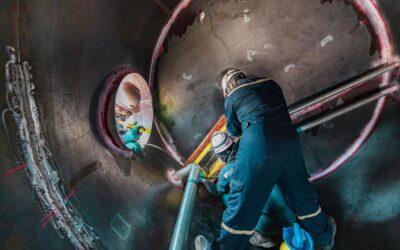
A tank rubber lining replacement is often completed in a matter of days by an experienced crew, on a shell that never leaves the pad. On a single mid-size vessel, that schedule difference alone can outweigh the entire cost of the lining, and it is the reason the lined tank market has shifted toward reline-first planning.
Rubber lining installation can often be completed in a matter of days, especially by experienced crews.
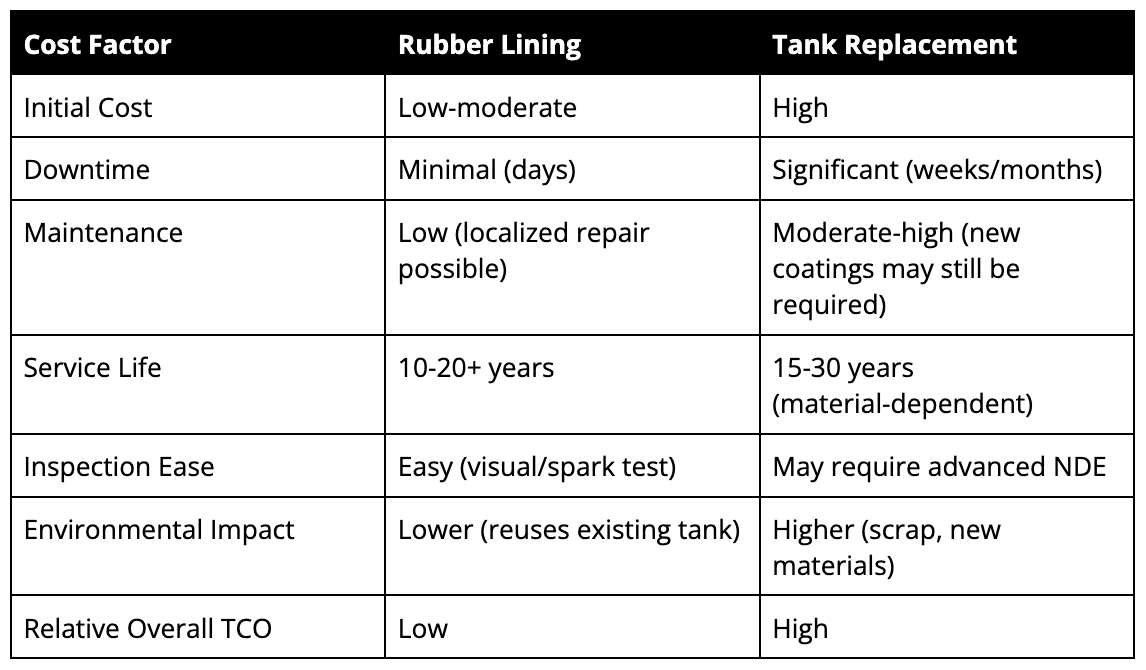
Total Cost of Ownership Comparison Chart
The Advantage of Rubber Lining Is Long-term ROI
New vessels may last slightly longer in some services, but the cumulative savings from rubber lined tanks, combined with a much faster return to service, typically produce a higher ROI across the asset’s lifespan.
Run the same 10,000-gallon vessel out 20 years and the gap widens. Replacement is $150,000 up front plus several weeks of lost production, and the new shell still needs a protective coating. Lining is roughly $50,000, with a second tank rubber lining replacement near year 15 at a similar figure. Two lining cycles still land below one replacement, and the vessel never leaves its foundation.
Additional advantages that keep buyers in the lined tank market:
- Customization – Rubber lining can be tailored for chemical resistance, abrasion, or thermal stability.
- Sustainability – Relining extends the life of existing infrastructure, supporting any company-wide ESG goals.
- Flexibility – Rubber lined tanks can be relined again in the future, deferring full replacement sometimes indefinitely.
When Tank Replacement Does Make Sense
There are some situations where replacement may be the better long-term option.
- Severe structural damage, like cracks or wall thinning, that rubber lining can’t help
- Significant deformation or pressure integrity issues
- Regulatory changes requiring full design updates
Outside those situations, rubber lined tanks remain the more economical, lower-risk answer to corrosion and chemical wear.
Maximize ROI with Rubber Lining from US RUBBER
At US Rubber, our team specializes in rubber lining installation, repair, and NACE-certified inspection services for tanks, vessels, and piping systems. Decades of work across chemical processing, water treatment, and heavy industry have shown us what the lined tank market actually rewards: linings applied right the first time and inspected on schedule.
Whether you are planning a tank rubber lining replacement for next year’s turnaround or dealing with an active corrosion problem right now, we can help you extend the life of your rubber lined tanks without draining your capital. Let’s work together.