Industrial tanks face chemical attack, abrasion, heat, and constant mechanical stress, so the protective system you choose directly affects lifespan, safety, and maintenance cost. The short answer: the difference between tank lining and coating comes down to thickness and duty. A coating is a thin film for mild, low-abrasion service, while a rubber lining is a thick, bonded barrier built for aggressive chemicals, heat, and solids. Choosing the right tank lining and coating approach prevents premature failure and costly downtime. This guide breaks down how each system works, when each one fits, and how our coating and lining services protect your equipment.
What Is a Tank Coating?
A tank coating is a thin-film protective layer, usually epoxy, polyurethane, or vinyl ester, applied in mils to shield a tank from general corrosion and environmental exposure. It forms a hard, chemically resistant barrier between the substrate and the tank’s contents. Coatings deliver chemical resistance against mild acids, alkalis, and water-based solutions, corrosion protection for steel and concrete, UV and weather resistance, and quick installation with minimal downtime. On the coating side of a tank lining and coating comparison, this is the lighter-duty, lower-cost option, and it defines one half of the difference between tank lining and coating.
When a Coating Is the Right Choice
Coatings suit non-aggressive conditions: mild chemical exposure, low-abrasion environments, atmospheric or intermittent service, and water storage with minimal solids. In these settings chemical attack is limited, temperatures are moderate, and mechanical damage risk is low, making a coating cost-effective. Their limits still matter: thin films have poor impact resistance, limited chemical tolerance at high concentration or extreme pH, no tolerance for high heat, and microporosity that can allow slow underfilm corrosion. Weighing those limits sits at the core of any tank lining and coating decision, and it is where our coating and lining services add value.
What Is a Rubber Lining?
A rubber lining is a thick, bonded elastomer layer, applied in fractions of an inch, typically 1/8″ to 1/2″, and engineered for harsh, high-demand service. That thickness gives it the strength and flexibility to withstand extreme chemical, thermal, and mechanical stress that would crack a rigid coating. Rubber linings deliver exceptional chemical resistance to acids, alkalis, and solvents, high abrasion resistance for slurries and solids, impact absorption, thermal resistance, and long-term corrosion protection through a fully bonded, impermeable barrier. This is the heavy-duty half of the tank lining and coating comparison, common in petrochemical, mining, steel, and water treatment.
Common Rubber Lining Materials
Material selection depends on the service environment. Natural rubber excels at abrasion and mild chemical service, neoprene is versatile and oil-resistant, chlorobutyl and bromobutyl resist strong acids, and nitrile performs well in hydrocarbon environments. Each can be tailored to exact chemical, abrasion, and temperature requirements, which is why professional coating and lining services start by matching material to duty. The wrong elastomer swells, hardens, or delaminates in service, so material choice is as important as thickness when scoping a tank lining and coating job.
When a Rubber Lining Is the Superior Choice
Rubber linings excel in severe service where failure is costly or dangerous: high-temperature or steam-assisted processes, aggressive acids and caustics, abrasive slurries, mining and hydrotransport, steel-mill pickling lines, and chemical processing tanks. Because they are thicker, more flexible, and more chemically resistant, rubber linings often last decades where coatings fail in months. Understanding that gap is central to the difference between tank lining and coating and to every tank lining and coating specification.
Tank Lining vs. Tank Coating: A Head-to-Head Look
The differences are fundamental, not subtle. Coatings provide thin-film chemical protection for light-duty environments, while rubber linings deliver heavy-duty, long-term defense against the most aggressive conditions. Coatings can look cost-effective up front, but frequent recoating, downtime, and tank failures often exceed the cost of a one-time rubber lining. That is why the difference between tank lining and coating shows up most clearly in lifecycle cost. For chemical processing, mining, and steel production, correctly scoped tank lining and coating decisions cut long-term maintenance and unplanned outages.
Comparison Table: Tank Coating vs. Rubber Lining

On the specifics, the contrast is clear. Coatings are measured in mils and typically deliver a few years of service before recoating, tolerate only mild to moderate chemistry, offer limited abrasion resistance, and hold up in moderate temperatures. Rubber linings are measured in fractions of an inch, routinely last one to three decades, handle strong acids and caustics, absorb heavy abrasion and impact, and tolerate elevated and fluctuating heat. That performance spread is the practical meaning of the difference between tank lining and coating, and it should anchor any tank lining and coating budget you build.
Performance Factors to Consider
The real decision comes down to your tank’s service environment. Evaluate the chemical environment first, since mild or low-concentration media may allow a coating while strong acids, caustics, and oxidizers require a rubber lining. Consider operating temperature, because heat degrades thin films but rubber linings flex and expand without cracking. Factor in abrasion and solids, which wear coatings quickly but are absorbed by linings. Then weigh pressure and mechanical impact, tank material, since linings bond well to steel, concrete, and FRP, required lifespan, downtime tolerance, and industry compliance standards. Balancing these variables is exactly what our coating and lining services are built to do, and it defines any sound tank lining and coating plan.
Installation Differences
Installation quality drives long-term performance for both tank lining and coating systems. Coatings are simpler to apply, while rubber linings require a specialized, controlled process, which is part of why they perform better in severe service.
Coating Installation
Tank coatings are applied as thin liquid films that cure into a hard layer. The process involves surface preparation by abrasive blasting to the correct profile and cleanliness, application of multiple thin layers to build dry-film thickness, and ambient curing controlled for humidity and temperature to avoid amine blush or solvent entrapment. Coatings cure faster and are easier to apply but are more vulnerable to installation inconsistencies. Proper prep is one of the biggest variables in any tank lining and coating project.
Rubber Lining Installation
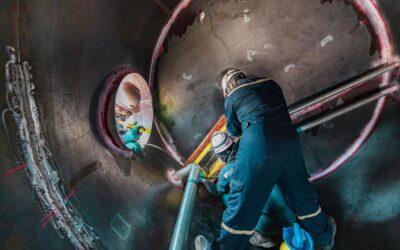
Rubber linings demand specialized expertise and precise bonding. Steel or concrete is blasted to AMPP standards, primer and adhesive systems are applied for a strong bond, and sheets are hand-stitched and pressure-rolled to eliminate trapped air. Curing is followed by steam vulcanization, autoclave, or chemical cold cure, and quality assurance includes spark testing and patching of holidays. Because linings are thicker and more complex, correct installation separates decades of service from premature failure, and it is the reason expert coating and lining services matter to any tank lining and coating program.
Maintenance and Inspection Over the Tank’s Life
Both systems need periodic inspection, but frequency differs sharply. Coatings, being thin, need frequent visual checks for cracking, blistering, and pinholes, monitoring for chemical attack in immersion or splash zones, spot repairs, and full recoating cycles every few years. Rubber linings offer long, predictable service intervals with periodic visual inspection, regular spark testing, and simple patch repairs that often avoid a full shutdown. This maintenance gap is a defining part of the difference between tank lining and coating and a key input to any tank lining and coating budget.
So Which One Do You Actually Need?
Choosing the right system comes down to one question: what conditions will your tank actually face? Choose a coating when conditions are mild and predictable, with light chemical exposure, minimal abrasion, low stable temperatures, tighter upfront budgets, and acceptable downtime for future recoats, such as water storage or atmospheric service. Choose a rubber lining when service is aggressive or variable, involving strong acids and caustics, abrasion from slurries and solids, elevated or fluctuating temperatures, multi-decade protection needs, and minimal downtime in mining, steel, petrochemical, or water treatment. If your tank faces even one severe-service condition, a rubber lining is usually the safer long-term choice. When in doubt, match your tank lining and coating decision to the harshest condition the equipment may see, and lean on the difference between tank lining and coating to guide the call.
Why Partner With US Rubber for Tank Linings
Selecting the right system is only half the job, since installation expertise delivers the other half. US Rubber provides rubber lining solutions for the most demanding industrial applications, backed by 40+ years of severe-service experience. Our turnkey process covers SSPC surface preparation, primer and adhesive systems, hand-stitched and pressure-rolled installation, steam, autoclave, or chemical cure, and post-cure inspection with spark testing. We line storage tanks, pressure vessels, clarifiers, railcars, reactors, scrubbers, and large-diameter piping across petrochemical, mining, water treatment, steel, nuclear, and battery production. With a focus on lifecycle cost, our coating and lining services reduce downtime, extend tank life, and improve safety. Ready to choose between a coating and a rubber lining? Contact US Rubber to request a consultation or quote, and put our tank lining and coating expertise to work.