Industrial rubber linings are designed to protect tanks, pipes, and process equipment from the harshest operating conditions, including corrosive chemicals, abrasion, high temperatures, and constant mechanical stress.
But even the highest-quality lining materials can only perform if they’re installed perfectly. A single pinhole, thin spot, or void in the lining is enough to allow chemical infiltration, leading to premature failure, contamination, and costly unplanned downtime.
That’s why spark testing is one of the most important steps in any rubber lining installation.
For operators in chemical processing, mining, wastewater treatment, and other heavy-industrial environments, spark testing is a non-negotiable quality-control step. Let’s dive in deeper.
What Is Spark Testing? How Does It Work?
Spark testing is a non-destructive electrical method used to detect pinholes, voids, cracks, and other discontinuities in rubber linings. It works by applying a controlled voltage across the surface of the cured lining.
- If the lining is flawless, the electrical charge remains on the surface.
- If there’s a defect — even one too small to see — the charge will “jump” through the opening and make contact with the metal substrate beneath.
- This produces a visible spark and an audible signal, immediately alerting the technician to the exact location of the flaw.
Because rubber linings are typically thick and non-conductive, spark testing is the most reliable way to confirm complete lining continuity. Traditional visual inspections can miss microscopic defects. A proper spark test verifies 100% of the surface area quickly and accurately.
Note: Technicians adjust the voltage based on the lining thickness and material type to prevent damage to the rubber while still detecting even the most minor inconsistencies.
Put simply: Spark testing ensures that the lining is doing its job, forming a durable and uninterrupted barrier between the equipment and the corrosive or abrasive materials it will contain.
The Importance of Spark Testing & Industrial Rubber Linings
Rubber linings are designed to withstand aggressive environments — from strong acids and caustics to abrasive slurries and extreme temperatures.
However, the performance of any lining system ultimately depends on one critical factor: whether or not the barrier remains completely intact.
Spark testing confirms integrity before the equipment is ever put into service.
When it comes to rubber linings, spark testing:
Prevents Chemical Infiltration and Corrosion
Even a pinhole-sized defect can allow chemicals to penetrate the lining and attack the steel substrate. Left undetected, this leads to underfilm corrosion, blistering, and eventual failure of the tank or vessel.
Spark testing verifies that there are no weak points where corrosion can begin.
Protects Product Quality and Safety
Many lined tanks hold chemicals, water treatment media, food-grade solutions, or sensitive process materials. Any leak or reaction caused by an exposed metal surface risks contamination, safety hazards, and unplanned shutdowns.
Spark testing ensures that the tank is safe to fill, eliminating that risk.
Reduces Long-Term Maintenance Costs
Equipment failures caused by lining defects are far more expensive to fix after the tank is in service.
A spark test takes minutes but can prevent costly repairs, re-lining, or complete equipment replacement down the road.
Ensures the Lining Was Installed Correctly
Proper installation is crucial to the performance of the lining. Spark testing confirms:
- The lining thickness is uniform
- Seams and overlaps are sealed
- Repairs or patch areas are fully bonded
- No air pockets or voids are present
Meets Industry and Compliance Standards
Industries such as chemical processing, mining, wastewater, and power generation rely on inspection standards like ASTM D5162 and NACE SP0188.
Performing a documented spark test ensures the lining meets these recognized requirements.
Types of Spark Testing: High-Voltage vs. Low-Voltage
Spark testing can be performed using two primary methods. While both are used to detect flaws in protective linings, they serve different purposes, and only one is suitable for industrial rubber linings.
Below is a breakdown to help clarify when each method is used:
Low-Voltage (Wet Sponge) Testing
Best for: Thin, conductive, or lightly coated surfaces
Not suitable for: Thick rubber linings
Low-voltage testing utilizes a damp sponge connected to a low-voltage detector (typically operating at voltages under 100 volts).
As the sponge is drawn across the surface, the system detects a defect wherever moisture comes into contact with the substrate.
This method is ideal for paint, epoxy, or thin-film coatings, but it cannot penetrate thick, non-conductive rubber compounds, making it ineffective for industrial rubber lining applications.
High-Voltage Holiday Testing
Best for: Rubber linings, spark tests for FRP linings (fiber-reinforced polymer), and other thick, non-conductive barriers
Voltage range: Often 5,000–30,000+ volts, depending on lining thickness
High-voltage testing uses a wand or brush electrode to deliver a controlled electrical charge to the lining surface. If the lining has even a micro-defect, the voltage arcs through and creates a visible spark at the fault.
Technicians set the voltage according to standards such as ASTM D5162 and NACE SP0188, which outline safe voltage levels based on:
- Material type
- Total lining thickness
- Application environment
For rubber linings, which are typically 1/8″ to 1/2″ thick, high-voltage spark testing is the only reliable method to confirm continuity.
Summary Table:
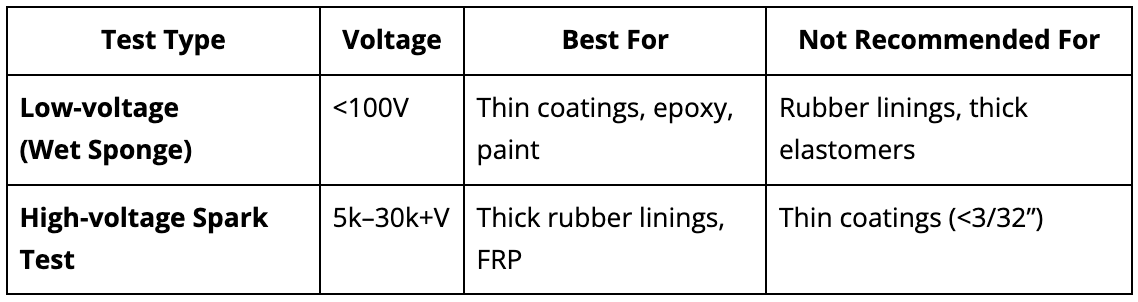
High-voltage spark testing is the industry standard for rubber-lined tanks and equipment because it delivers the sensitivity and depth required to detect defects in thicker material systems.
When Should Spark Testing Be Performed?
Spark testing isn’t a one-time procedure. It’s used at several key points in the lifecycle of a rubber-lined tank or piece of process equipment:
1. After Initial Lining Installation and Cure
This is the most critical stage. Once the rubber lining has fully cured, technicians perform a spark test to confirm the lining is continuous and free of:
- Pinholes
- Thin spots
- Air pockets or blisters
- Defects in seams or overlaps
No tank should be approved for service until it passes a certified spark test.
2. After Any Repairs or Patch Work
Whenever a section of rubber lining is cut out and replaced (whether due to wear, chemical attack, or mechanical damage), the repair area must be spark tested. This ensures the patch is fully bonded and defect-free.
Even small repairs introduce potential failure points, so spark testing is essential for verifying the integrity of the patch.
3. During Scheduled Shutdowns and Preventive Maintenance
Facilities in chemical processing, mining, wastewater, and pulp & paper industries often include spark testing as part of periodic inspection cycles, especially when tanks operate under:
- High corrosion risk
- Continuous chemical exposure
- Abrasive slurry movement
- Elevated temperatures
Routine spark testing helps detect early-stage deterioration before it leads to operational downtime or liner failure.
4. Before Returning Equipment to Service After Long Idle Periods
When tanks remain unused for extended periods, environmental factors (such as humidity, vapor exposure, or structural movement) can compromise the integrity of the lining. A spark test provides confidence that the equipment is safe to operate again.
5. On Both Rubber and FRP Linings
While this blog focuses on rubber linings, spark testing is also commonly used on:
- FRP (fiberglass reinforced plastic) linings
- Thick elastomeric coatings
- Chemical-resistant barrier systems
This makes spark testing a versatile inspection method across many industrial applications.
Spark Test Standards and Requirements
Spark testing must follow established industry standards to ensure the correct voltage, safe testing practices, and accurate defect detection. These guidelines protect the lining from damage and provide documented proof of quality control:
ASTM D5162 — Holiday Testing of Nonconductive Coatings
ASTM D5162 is the primary reference for spark testing. It outlines:
- Proper equipment selection
- Recommended voltages based on lining thickness
- Safe test procedures
- Documentation requirements
Rubber linings are subjected to high-voltage testing, where technicians select the voltage according to the material’s thickness to prevent burning or puncturing.
NACE SP0188 — Best Practices for Spark Testing
NACE SP0188 complements ASTM by defining:
- Calibration and grounding steps
- Environmental conditions for testing
- Inspector competency requirements
Many industrial facilities reference both ASTM and NACE standards to ensure consistent and repeatable testing results.
Industry-Specific Requirements
Some sectors, particularly chemical processing, mining, and storage tank fabrication, follow additional recommendations from API or internal QC standards. These may require:
- Spark testing before hydrotesting
- Corrective repair protocols
- Documented test reports for compliance
Why Do These Standards Matter?
Using established standards ensures spark testing is:
- Accurate
- Non-destructive
- Repeatable
- Compliant with industry expectations
For customers, this means the rubber lining has been verified using proven, internationally recognized methods.
How US RUBBER Ensures Proper Spark Testing
At US Rubber, spark testing is a standard part of every rubber lining installation. It’s included not as an optional add-on but as a core quality-control step that ensures each tank, pipe, or vessel meets the performance expectations required for heavy industrial service.
Inspection Completed After Full Cure
US RUBBER tests linings only after they have fully cured. This ensures:
- Accurate defect detection
- Stable, permanent adhesion
- No voltage-related damage
Testing too early can produce false readings or harm the lining — our process avoids both.
Integrated Into Turnkey Lining Services
Because US Rubber handles both installation and testing, customers benefit from:
- Single-source accountability
- Consistent standards
- Quicker turnaround
- Fewer contractors involved
This reduces project complexity and ensures that every lining is installed and verified by one expert team.
Protect Your Equipment With Verified, Defect-Free Rubber Linings
If you need a rubber lining solution that is built to last, backed by certified spark testing, and offers full turnkey support, US RUBBER is here to help.
Our team provides expert installation, inspection, and quality assurance to keep your equipment protected and your operation running safely.
Contact US RUBBER today to discuss your project or request a quote.